|
| None | __init__ (self, str port, **kwargs) |
| |
| typing.Dict[str, microscope.abc.Device] | devices (self) |
| |
| None | __del__ (self) |
| |
| bool | get_is_enabled (self) |
| |
| None | disable (self) |
| |
| None | enable (self) |
| |
| None | initialize (self) |
| |
| None | shutdown (self) |
| |
| None | add_setting (self, name, dtype, get_func, set_func, values, typing.Optional[typing.Callable[[], bool]] readonly=None) |
| |
| | get_setting (self, str name) |
| |
| | get_all_settings (self) |
| |
| None | set_setting (self, str name, value) |
| |
| | describe_setting (self, str name) |
| |
| | describe_settings (self) |
| |
| | update_settings (self, incoming, bool init=False) |
| |
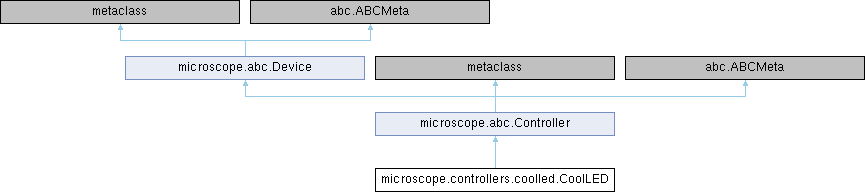
CoolLED controller for the individual light devices.

Args:
    port: port name (Windows) or path to port (everything else) to
        connect to.  For example, `/dev/ttyACM0`, `COM1`, or
        `/dev/cuad1`.

The individual channels are named A to H and depend on the actual
device.  The pE-300 have three channels named A, B, and C by
increasing order of wavelength of their spectral region.  The
pE-4000 have four selectable channels named A, B, C, and D with
channels E-H for peripheral devices via a pE expansion box.

.. code-block:: python

   # Connect to a pE-300 ultra and get the individual lights.
   controller = CoolLED('/dev/ttyACM0')
   violet = controller.devices['A']
   blue = controller.devices['B']
   red = controller.devices['C']

   # Turn on the violet channel.
   violet.enable()

CoolLED controllers are often used with a control pod which can
select/unselect and turn on/off individual channels.  The meaning
of these two states are:

* "selected" and "on": channel is always emitting light.  This is
  equivalent to being enabled with `SOFTWARE` trigger type.

* "selected" and "off": channel will emit light in receipt of a
  TTL signal.  This is equivalent to being enabled with `HIGH`
  trigger type.

* "unselected" and "off": channel nevers emit light.  This is
  equivalent to being disabled.

* "unselected" and "on": this is not possible.  If an "unselected"
  channel is turned "on" it reverts back to "off".

.. note::

   If a channel is set with `TriggerType.SOFTWARE` ("on") it will
   start emitting light once enabled ("selected").  Once enabled,
   even though trigger type is set to software and not hardware,
   if the channel receives a TTL signal it will switch to
   `TriggerType.HIGH` and continue to report being set to
   software.  This seems to be an issue with the CoolLED
   https://github.com/python-microscope/vendor-issues/issues/9

This was developed with a CoolLED pE-300 ultra but should work
with the whole pE-300 series.  It should also work with the
pE-4000 and the pE expansion box with the exception of loading
different sources.
Definition at line 234 of file coolled.py.

 Public Member Functions inherited from